July, 2008
The
Ever-Popular FTDOTC Mailbag
It's
officially the "dog days" of summer. Time for a mailbag.
Question: How do BDBL farm drafts
break down in terms of professional vs. amateur players, and has this
changed over the years?
This is a very intriguing question.
So intriguing, in fact, that it deserves its own FTDOTC article. I
plan to do a lot of this sort of "retrospective analysis" next year.
Which leads me to the next question...
Question: The league is almost ten
years old now -- did you expect this? What is your vision for the
next ten years? Looking back on the past ten years as
commissioner, do you have any favorite memories -- things that truly
surprised you, etc.? Anything in mind at season's end to
commemorate our 10th season?
I've actually been planning a bunch of
things to celebrate our 10th anniversary. These plans have been in
the works for over a year, but due to
procrastination, laziness and an unusually hectic schedule, I haven't
made as much progress as I'd hoped.
Last August, I came
up with the brilliant idea of writing an essay covering the history of
each of our
24 franchises. I began writing these essays in August, and so far
I've completed exactly 11 of them. So I'm not even halfway there,
and I don't have much time left to finish this massive project. I
had no idea how long this would take to do until I actually started
writing. Still, I plan to release two of these essays per month,
starting in November, and I hope people actually read them.
I've had two other major projects
(unrelated to our 10th anniversary) on my plate for well over a year as
well, and have made zero progress there. I've been meaning to
update the look and feel of this web site for several years, and I need
to rewrite our d-day code from SAS to PHP or we won't have a d-day
feature this year. So I really need to get crackin'.
Getting back to the original question,
I am not surprised at all that this league is still going strong after
nearly ten full seasons. When I first created this league, it was
with the intention of building something very long-term, as that would
best simulate reality. And I would have kept plowing forward no
matter how many obstacles fell into our path.
The latest obstacle, of course, is the
demise of the DMB standalone program. Once we're all forced to
switch over to Windows 7, and discover this game is no longer compatible
-- or once DMB stops issuing new player disks -- we'll have a very tough
decision to make in terms of how we'll proceed. But there is no
doubt in my mind that this league will continue in some shape or form.
I've had many fond memories in terms of
the people I've met, and the times we've all enjoyed on the board and
during BDBL Weekends. But any fond memories I've had of actually
playing this game have been completely obliterated by all my post-season
failures. I've become more than a little bitter and cynical over
the actual game itself, and I doubt that even a championship would erase
the bad taste left in my mouth over losing so many post-season series I
felt I "should" have won.
But I always enjoy putting together a
competitive team, from drafting to trading to free agency to contracts.
And I do enjoy the escape from reality the game provides during the
regular season (as frustrating as that can often be.) So to me,
this offsets all the post-season aggravation. (For the most part.)
Question: Are any of your sons
currently on the BDBL waiting list? (Your oldest must be near his
teens now.)
My oldest son just turned twelve.
And while he follows baseball pretty well, plays DMB on his own, knows
all the players and teams, watches "Sports Center" and "Baseball
Tonight," etc., I don't think he's ready to be fed to the lions just
yet. I'd say his knowledge of baseball right now is on par with
Phil Geisel or Billy Romaniello when they first joined the BDBL.
And you all know how that worked out.
Question: How about a look back at
D-Day's biggest bargains and busts?
Sure, why not? In terms of 2008 MLB performance so
far, here are some of the noteworthy busts (in no particular order):
- Jeff Kent, signed for $5.5M
by Great Lakes. Some of us thought Kent was a risky "Type H"
signing at age 40, and he's certainly proved to be that so far, as his OBP
has dipped below .300 (.295.)
- Travis Hafner, signed for
$7M by Las Vegas. True to his reputation, Johnny Bo took a
huge gamble by signing Hafner to a big Type H contract after such a
disappointing 2007 MLB season. So far, Hafner's hitting
.217/.326/.350, and looks to be done at the age of 31. But
Johnny's now on the hook for $14 million over the next two years,
with no out clause. Ouch.
- Brad Penny, signed for $12M
by Las Vegas. Poor Johnny Bo. He's on the hook for a
whopping $24 MILLION over the next two years, and so far, Penny's
posting a 5.88 ERA in over 85 innings. That's called a
high-risk/low-reward signing.
- Brett Myers, signed for $7M
by Villanova. And to think, I was actually pissed when I lost
the bidding war for Myers. So far, he owns a 5.84 ERA in 101+
innings, and has already served up 24 long balls. Yowza.
- Michael Young, signed for
$8M by Great Lakes. Notice a pattern here? Scott and
John really killed themselves on the free agent market last winter.
Young isn't having an awful season, but for $16 million over the
next two years, you'd like to see more than a .280/.333/.408 hitter.
- Rafael Betancourt, signed
for $5.5M by Las Vegas. Yet another lousy free agent signing
by Johnny Bo. Betancourt is currently sporting a 6.14 ERA in
36+ innings. Yowza again. If you're keeping track at
home, between Betancourt, Penny and Hafner, Vegas is on the hook for
a whopping $49 MILLION over the next two years, with no out clause
(barring early season-ending injury.)
- Rocco Baldelli, 6th round
pick of the draft by Atlanta. Balls-smelly was a good gamble
that just hasn't paid off. He's yet to take the field in MLB
'08, and probably won't for the remainder of the year. He's
already been released by Atlanta, and has been picked up by
Ravenswood. But given the latest news, he'll probably be
released again before the end of the season.
And now, the bargains:
- Mike Mussina, signed for
$3M by South Carolina. I doubt Tony D. was looking toward 2009
when he signed this 39-year-old stop-gap last winter. But the
Moose is having a decent year (3.93 ERA, with a 13/50 BB/K ratio, in
89+ innings) at a relatively bargain salary of $3 million.
- Jason Giambi, signed for
$2M by South Carolina. DeCastro strikes gold again!
The Mustachioed Wonder is having a resurgent season (.262/.396/.542, with 17 HR), to
the shock and disbelief of everyone I know.
- Curt Schilling, signed for
$5.5M by Southern Cal. I thought Bob took a huge, huge gamble
when he signed this injury-plagued 40-year-old to a Type-H deal.
But the guy lucked out big-time, as Schilling is now done for the
season (and probably his career) before throwing a single pitch.
So, for the low, low cost of just $5.5 million, Bob added a pitcher
who has given him a 9-3 record and a 2.89 ERA so far this season.
Not bad, eh?
- Aubrey Huff, 6th round
draft pick by Marlboro. When Sharky picked Huff with the 8th
pick of the round, he probably figured he was getting a decent
platoon player for 2008. But he probably didn't know Huff
would be hitting .275/.345/.500 at the end of June. (Or then
again, maybe he did. Sharky was pretty savvy that way.)
- Ryan Ludwick, 6th round
pick by New Hope. Boy, I never saw this coming.
.285/.362/.574 at the end of June, with 16 homers and 22 doubles?
From a 29-year-old who'd never posted more than 303 at-bats in the
big leagues, had surpassed 165 at-bats only once and had bounced
around with three different teams in the past five years? He
looked like a career 4th-outfielder to me, yet here he is ranked
among the top 30 hitters in MLB in terms of VORP.
Baseball...go figure.
- Justin Duchscherer, 6th
round pick by Salem. I really couldn't afford to take a $3
million pick in the 6th round, and taking this pick meant I would
have to make a couple of trades to fill some holes. But I felt
it was worth it to snag the Doucher. Like my Kelvim Escobar pick
from a couple of years ago, I felt Douchy would make a smooth
transition from the bullpen to the starting rotation. And so
far (1.91 ERA in 85 IP, with only 59 hits and 19 BBs allowed), so
good.
- Aaron Laffey, 13th round
pick by Akron. When I saw that a Cleveland Indians rookie
pitcher was mowing down big league hitters like a seasoned veteran,
I didn't need to look to see who owned him. There are only two
possibilities: Shepard or Stein. It turned out to be Shepard,
who took a $3 million gamble that has paid off well (3.24 ERA in 75
IP) so far.
- Hong-Chi Kuo, 17th round
pick by Atlanta. Gene Patterson went hunting for bargains in
the draft this year, and he certainly found a great one in Kuo,
who's posted a 1.76 ERA in 46 innings so far, with a BB/K ratio of
11/55. Not a bad return on a million-dollar investment.
- Dan Wheeler, 17th round
pick by Southern Cal. I'm pretty sure Wheeler was drafted to
fill innings in the Slyme's 2008 bullpen. In addition to that,
however, it looks like he may be the team's closer in 2009. In
37+ innings so far this season, he owns a 1.93 ERA, with only 22
hits and 25 K's.
- Dana Eveland, 22nd round
pick by New Milford. Whenever I hear this dude's name, I can't
help but think about Kimberly Drummond and Jan Brady. Granted,
he's done okay so far (3.34 ERA in 97 innings, but with 46 BBs), but
he still throws like a girl.
- B.J. Ryan, 21st round pick
by Bear Country. Matt Clemm gambled that Ryan would make a
full recovery from his injury-plagued 2007 season, and so far (28
IP, 31 K, 2.25 ERA), so good.
- Eric Hinske, 34th round
pick by Chicago. A 29-year-old utility player, coming off a
.204/.317/.398 season, suddenly hits .267/.351/.533 in half a
season? I'm sorry, but that's called a lucky pick.
- Nick Blackburn, 26th round
pick by Las Vegas. When I read the scouting report on Baseball
America's selection as the #1 prospect in the Twins organization, I
thought, "Man, the Twins farm system really blows." But half a
season later, that #1 prospect is sporting a 4.05 ERA in 97+
innings, with a 15/54 BB/K ratio. Boy, is my face red.
- Jorge Cantu, 30th round
pick by Marlboro. The good news for Marlboro fans: Sharky had
the foresight to select Cantu (.278/.328/.475 with 14 HR) in the
30th round of the draft. The bad news: he didn't have the
foresight to hold onto him.
- John Lannan, 26th round
pick by New Hope. When Badger drafted John Lannan with the
first pick of the $100K rounds, I joked on the forum that I would
draft Mark David Chapman with my next pick, just to get a good
match-up. But the joke's on me now, as Badger managed to flip
that pick for John Smoltz. In 94 innings, Lannan has posted a
3.54 ERA so far, with a 29/56 BB/K ratio and 12 homers allowed.
- Salomon Torres, 26th round
pick by Kansas. Torres' performance so far (2.62 ERA in 44+
IP) is exactly what you hope for when you gamble on a late-draft
reliever.
- Matt Thornton, 30th round
pick by Kansas. Ditto Matt Thornton (31+ IP, 16 H, 9 BB, 40 K,
2.30 ERA.)
- Edwar Ramirez (27th pick)
and Bill Bray (32nd pick) by Salem. These two will
forever be linked together, so I may as well list them together.
Combined, they've posted a 3.06 ERA in 50 innings, with 42 hits
allowed, 26 walks and 50 K's. Yeah, they pretty much suck.
- Brian Matusz, 2nd round
farm pick by Los Altos. To snag the best pitcher in this
year's draft in the second round of the farm draft, at this stage of
the league's evolution, is a very impressive feat. But to do
it with the 23rd pick of the round makes Jeff Paulson the legend
that he is.
- Justin Masterson, 1st round
farm pick by Cleveland. Some people poo-pooed this pick -- the
17th pick of the first round. But let the record show I wasn't
one of them. Masterson has already pitched 42 innings in the
Show, with just 29 hits allowed, 32 whiffs, and a stellar 3.43 ERA.
When you consider that some of the players selected ahead of him
were Cole Rohrbough, Jack McGeary, Masahide Kobayashi, Matt Latos
and Peter Kozma, this was a GREAT pick.
- Max Ramirez, 2nd round farm
pick by San Antonio. After pounding the Texas League into
submission, Ramirez is now in the big leagues. Not bad for a
second-round pick.
- Matt Gamel, 4th round draft
pick by San Antonio. All Gamel has done this year is hit
.379/.442/.636 with 27 doubles and 15 homers. Unfortunately
for Greg, Gamel was traded for Ramon Hernandez (and has been traded
twice since then!)
I know, I know. I missed a
shitload of players. I'm sure I'll hear all about my
"anti-fill-in-the-blank" bias on the forum. But I don't have hours
to cross-reference hundreds of players, so this is all just off the top
of my head! "Mailbag" articles aren't supposed to require lots of
work.
Question: What has been the
historical track record for contending teams who decide to bail
mid-season and start rebuilding?
Unfortunately, the track record for
these teams has been very, very good:
- The 2007 SoCal Slyme were perhaps
the most notorious of all the mid-season white-flag-waving
contenders this league has seen in our nine and a half seasons.
Despite managing a team that ended up winning the EL wild card, Bob
Sylvester bailed early and often with this team, trading Roger
Clemens, Paul Konerko, Anibal Sanchez, Raul Ibanez and Jose
Contreras, among others. The result? The Slyme currently
own the best record in the BDBL, and have to be considered the
favorites to win it all in '08.
- In 2005, Anthony Peburn
slashed-and-burned his way into BDBL infamy with the biggest
firesale in league history. With the Blazers finally hovering
around the .500 mark after seven miserable seasons of failure, Peburn sold every remotely-valuable player on his roster, including
Shannon Stewart, Melvin Mora, Brad Lidge, Juan Pierre, Todd Helton,
Aki Otsuka, Orlando Hernandez and Tom Gordon -- all in one chapter.
The result: New Milford won the OL championship the following
season.
- That same year (2005), Tony Chamra
of the Villanova Mustangs went into the winter with a team that was
easily good enough to contend for a playoffs spot. Instead, he
"bought" several prospects in exchange for hefty penalties ($17.8
million in total) and left $5.8 million sitting on the table at the
free agent draft. The result: Chamra won the BDBL championship
the following year.
- Again, that same year, the Chicago
Black Sox were picked to win their division. But after tanking
the first chapter, GM John Gill began trading away his star-studded
roster piece by piece. Unlike the others above, however,
Chicago went just 70-90 the following year.
- Finally, in 2002, the Kansas Law
Dogs owned a .648 winning percentage after two chapters of play.
They trailed the Allentown Ridgebacks by four games in the division,
and led the Phoenix Predators by two games in the wild card race.
But with roughly three weeks remaining in Chapter Two, Kansas GM
Chris Luhning began frantically waving the white flag. He
began by trading away MVP candidate Luis Gonzalez and all-star
catcher Ivan Rodriguez. Not only did he trade both players,
getting young prospects in return, but he traded them to the team he
was battling with in both the division and the wild card race -- the
Predators! Roughly six weeks later, the deconstruction
project continued, as Luhning dealt all-stars Mike Sweeney and Carl Everett
to the Cleveland Rocks in exchange for more young players. The
result: Kansas jumped from 82 wins in 2002 to 101 in 2003.
So I guess the moral of the story is
that it pays to be a pussy.
Question: Do strikeouts correlate in
a negative way to runs scored (offensively?) That is, do teams
that strike out more often tend to be worse offensively, or does it not
matter?
To get the answer to this question, I
looked at only the past two and a half seasons (2006-2008.) I then
calculated the number of strikeouts per 27 outs (defining an "out" as
at-bats minus hits, so we don't count sac flies or bunts), and the
number of runs per 27 outs. I then did the ol' handy-dandy "correl"
function in Excel, and came up with a number of .15.
In other words, there is no significant
correlation between run scoring and strikeouts. In fact, the
slight correlation here is POSITIVE -- meaning teams that strike out
more often tend to score MORE runs than teams that fly-out or
ground-out.
Here is a graph showing strikeout rate
at the top and run-scoring rate at the bottom:
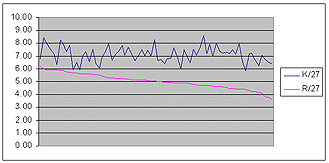
As you can see, there doesn't seem to
be any pattern or similarity at all between the two lines. It is
interesting to note, however, that of the top ten teams in runs scored,
four of those teams also rank among the top ten in strikeout rate.
And three of the teams ranked among the bottom ten in runs scored also
rank among the bottom ten in strikeouts.
I think the reason for this slight
correlation is that teams that strike out a lot also tend to hit more
home runs, and homers correlate strongly with run scoring. The statistics back this theory, as the correlation
between the home run and strikeout rates is .33 -- still statistically
insignificant, but more than twice as significant as the correlation
between strikeouts and run scoring.
Question: What does the 2009 free
agent class look like at this point?
It's always difficult to predict at
this point in the season, but I'll give it a go. As near as I can
tell, the top 25 free agents (in terms of 2008 VORP only) look something
like this:
1. Lance Berkman
2. J.D. Drew
3. Johan Santana
4. Jermaine Dye
5. Johnny Damon
6. Hideki Matsui
7. Brandon Webb
8. Brian Giles
9. Derrek Lee
10. Xavier Nady
11. C.C. Sabathia
12. Carlos Guillen
13. Vladimir Guerrero
14. Jim Thome
15. Derek Lowe
16. Brad Lidge
17. Bobby Abreu
18. Aaron Harang
19. Francisco Cordero
20. Wandy Rodriguez
21. Todd Helton
22. John Smoltz
23. Chad Gaudin
24. David Eckstein
25. Greg Maddux
This looks like your usual mix of aging
vets (Dye, Damon, Matsui, Giles, Abreu, etc.), dominant aces (Santana,
Webb, Sabathia) and one or two dominant hitters (Berkman and Drew.)
If past history is any indication, those three aces should each fetch
$20 million or more, and Berkman should get a healthy pay raise to about
$14-$15 million. Bastard.
Question: What are the most valuable
contracts in the BDBL, as calculated by the Glander Formula?
This is another question that requires
far more work and research than I care to do -- at least for a "mailbag"
article. But if I did all of that legwork, and calculated future
market value based on projections, and then subtracted future salaries,
etc., I'd bet my top 20 would look something like this:
1. Tim Lincecum (ALN)
2. Felix Hernandez (ALN)
3. Hanley Ramirez (SCA)
4. David Wright (KAN)
5. Troy Tulowitzki (CLE)
6. B.J. Upton (MAN)
7. Evan Longoria (CHI)
8. Matt Cain (KAN)
9. Chad Billingsley (VIL)
10. Cole Hamels (MAN)
11. Chase Utley (LVF)
12. Dustin McGowan (SAL)
13. Scott Kazmir (MAN)
14. Adam Wainwright (LAU)
15. Joe Mauer (COR)
16. Daisuke Matsuzaka (NAS)
17. Justin Verlander (AKR)
18. Russell Martin (CLE)
19. Shaun Marcum (LAU)
20. Dan Uggla (NAS)
21. Adrian Gonzalez (LAU)
22. Josh Hamilton (LAU)
23. Ryan Braun (ALN)
24. Justin Upton (LAU)
25. Prince Fielder (COR)
26. Casey Kotchman (VIL)
27. Grady Sizemore (NHB)
28. Jay Bruce (SAL)
29. Alex Gordon (LAU)
30. Edinson Volquez (SAB)
Honorable mention: Carlos Quentin
(KAN), Jair Jurrjens (ATL), Matt Kemp (SAL), Kosuke Fukudome (KAN),
Joba Chamberlain (STL), John Danks (ATL), Jon Lester (LAU), Gavin
Floyd (GLS)
You may recall that I wrote a FTDOTC
article a couple of years ago dedicated to answering this question.
At that time, my top ten was David Wright, Joe Mauer, Miguel Cabrera,
Albert Pujols, Jason Bay, Grady Sizemore, Carlos Zambrano, Francisco
Liriano, Brandon Webb and Chase Utley. I remarked at the time that
it was interesting to note that five of those ten were acquired via
trade. Here's how the current top 30 break out in terms of how
they were acquired:
Via trade: 20
Via farm/free agent drafts: 10
So if you've traded one of those
hugely-valuable franchise players above (and I've traded six of them
myself), don't kick yourself too hard, because you've got plenty of
company. |


